
When you’re trying to figure out how to drive sustainable campus growth, the biggest hurdle is rarely a lack of passion. Instead, it is the constant battle against member burnout, low event turnout, and stagnant fundraising numbers. When a club relies entirely on its internal board to generate momentum, its reach inevitably hits a ceiling. To break out of this bubble, student leaders must look outward. Launching and scaling successful non profit organizations for students on campus requires a shift from an isolated club model to a community-wide collaborative network. The award-winning MEDLIFE chapter at the University of Michigan-Flint recently proved that the secret to explosive campus growth lies in two pillars: diversified local partnerships and deeply inclusive leadership.
Diversify Partnerships to Maximize Fundraising Success
When brainstorming initiatives, many campus groups fall back on predictable, low-yield bake sales or basic flyer distributions. The UM-Flint executive board challenged this norm by building a massive network of corporate and local community partners. As Chapter Service Learning Trip Director Naima told us, her team aggressively pursued diverse collaborations to support their fundraising goals:
“This year, we focused on partnership and fundraising, and we partnered and fundraised with the Rotten Manor Haunted Attraction, Culver’s, the Grand Blanc Auto Wash, we even partnered with the UM-Flint hockey team selling raffle tickets.”
By stepping outside the medical department to work with local sports teams, businesses, and entertainment venues, the chapter successfully raised over $2,000 for MEDLIFE’s Moving Mountains campaign and over $1,500 to fund their Service Learning Trips.
Expand Your Network to Boost Campus Engagement
Beyond corporate sponsorships, building non profit organizations for students requires integrating seamlessly with existing university infrastructure. UM-Flint’s Vice President, Andrew, shared that collaborating with institutional giants, like the Michigan State University College of Human Medicine and local blood centers, simultaneously grew their on-campus outreach and provided members with direct, career-boosting professional networks.
Chapter Treasurer Madison also explained that these collaborative efforts naturally increased club attendance, expanded their professional visibility, and drastically enhanced their chapter’s credibility.
If you’re looking to optimize your campus recruitment strategy, partnering directly with neighboring pre-dental and pre-med clubs can help ensure your organization stops competing for student attention and starts centralizing it under a shared mission.
Shift Focus From Events to Genuine Relationships
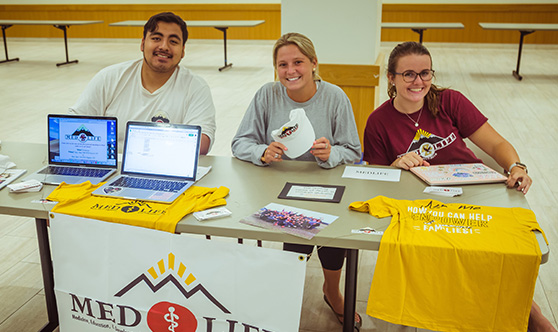
The ultimate takeaway from UM-Flint’s success is a lesson in sustainable leadership structure. True, long-term growth happens when general members are treated as co-creators rather than passive event volunteers. By actively involving students in the early planning and decision-making phases of their campaigns, the board was able to cultivate a highly dedicated community centered around service leadership and healthcare access.
To implement this model and scale successful non profit organizations for students, UM-Flint President and Founder Paulina Rivera offers definitive, foundational advice for future leaders:
“My advice is to plan ahead during summer and winter breaks, set goals for yourselves and timelines early, along with involving your entire team so that everyone has the opportunity to get involved. Focus on building those relationships and not just hosting those events.”
By focusing on authentic relationship-building rather than simply checking off event logistics, any MEDLIFE chapter can build a powerful, lasting legacy that keeps its momentum going year after year.
If you are interested in joining or starting a MEDLIFE Chapter, fill out the interest form below!